ThomasNet is no newcomer on the digital advertising scene. For ages, industrial manufacturers and suppliers have leaned on their reputation as the go-to directory for serious buyers. But while that legacy might be comforting, it also means their aggressive new push into “performance-based” listings, a PPC-style advertising gamble, deserves real scrutiny. Are we witnessing smart innovation, or just old-school marketing wrapped in digital buzzwords?
On the surface, the pitch is seductive. Only pay when there’s “interest,” with the promise of higher intent, better ROI, and numbers you can actually measure. But dig a little deeper, and the cracks begin to show. Advertisers quickly find themselves scratching their heads, asking, “Did I just pay for a curious click, or is there a real buyer behind the curtain?” “Is this seemingly real buyer actually spam, a fraud, or someone selling me freight forwarding services?” Do you sense the apprehension or even frustration, perhaps?
This isn’t a wholesale rejection of performance-based listings, nor a blanket warning to run for the hills. But let’s call it what it is: a hard-nosed, skeptical look at what really happens after the ad dollars are spent and the so-called “leads” land in your sales rep’s inbox.
At the heart of ThomasNet’s performance-based listings is the concept of an evaluation click. These are positioned as meaningful buyer actions. The problem is that the definition of “meaningful” is doing a lot of work here. Evaluation clicks can include basic profile views, category browsing, or exploratory clicks that feel closer to window shopping than sourcing. None of these actions reliably signals that a buyer is ready to engage in a sales conversation.
Unlike Google Ads, where advertisers define conversion events and optimize toward outcomes that matter to them, ThomasNet decides what qualifies as billable engagement. As an advertiser, you pay for the click whether it leads to a qualified opportunity or a dead end. That difference alone should give cautious marketers pause.
What Actually Needs Evaluation: Traffic Volume vs Buyer Quality
For most advertisers, one of the most common frustrations is online traffic quality. ThomasNet’s performance-based listings might generate activity, but it’s not always likely to translate into a real sales opportunity. Reportedly, the heightened traffic frequently includes students doing research, overseas companies with no buying authority, competitors keeping tabs on the market, and salespeople prospecting suppliers. The metrics look healthy. The sales pipeline does not.
From a sales perspective, this creates a familiar but unwelcome scenario. More names, more emails, more calls, and very few conversations that resemble a real buying process.
When Paid Leads Try to Sell to You
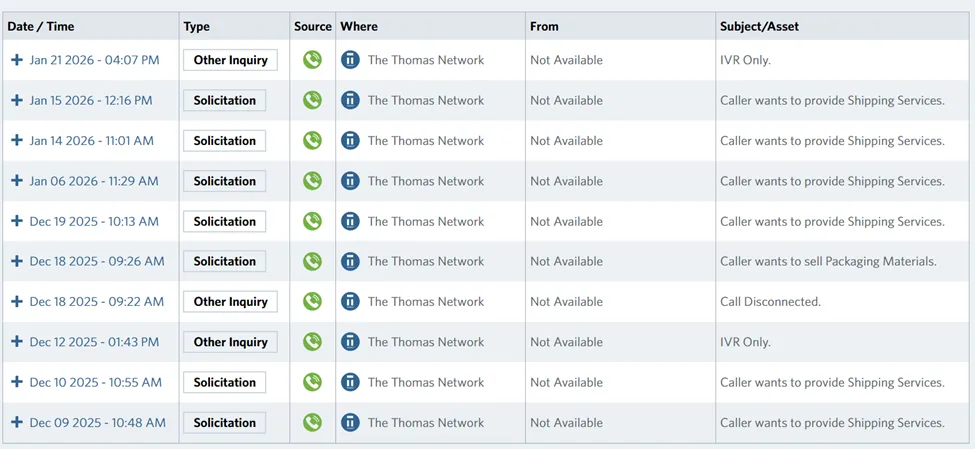
Perhaps the most demoralizing outcome of paid ads is realizing you are paying to be pitched to – ouch! That must hurt a lot. Manufacturers routinely report inquiries from freight brokers, overseas service providers, financing companies, staffing firms, and software vendors. These inquiries still show up on your campaign dashboard as RFQs or contact form submissions. They still require review. They still interrupt sales teams. And it’s all for nothing.
See examples of freight companies clicking on your phone number and calling you:
The Unavoidable Test: Reviewing Every RFQ
Clicks and form fills are easy to count. Revenue is harder. That is why the real test of any advertising channel happens after the inquiry arrives. See what happens if you audit your ThomasNet RFQs. You will notice patterns: incomplete requests, no specifications, spam, no timelines, requests that fall outside your capabilities, generic “contact me” messages with no buying context, and duplicate submissions that go nowhere.
Each one costs time. Each one pulls attention away from legitimate or real sales opportunities. When advertising spend creates an administrative burden instead of revenue momentum, skepticism is a rational response. If your marketing budget is sucked into a black hole of clicks and empty leads, leaving your sales team tangled in endless busywork, it’s time to ask: What are you really paying for? Every wasted dollar should sting. Are you funding growth or just fueling the hamster wheel of digital distraction?
Useless Reporting That Stops Short of What Matters
ThomasNet dashboards emphasize activity metrics: clicks, views, submissions; all numbers that can appear impressive in isolation. But what happens next? How many inquiries became qualified opportunities? How many led to quotes? How many turn into paying customers?
This is where the comparison to Google Ads becomes unavoidable. Google Ads is far from perfect, but at least it allows you to connect your PPC spend to outcomes, refine Geo targeting, exclude waste, and optimize ad campaigns based on closed-loop data. On the other hand, with ThomasNet performance-based listings, many advertisers are already saying that they are simply handed engagement data and left to infer business impact on their own.
Control, Transparency, and Who Carries the Risk
Modern paid advertising platforms must give advertisers meaningful levers. Audience exclusions, conversion definitions, source transparency, and bid controls are all completely justified expectations. But ThomasNet offers far less flexibility. Traffic sources are largely opaque, and filtering options are limited. You have very little say in what qualifies as a valuable interaction stemming from your listing. The result is a model where you assume most of the risk as the advertiser, while the platform benefits from engagement volume. (That imbalance explains why even some ThomasNet salespeople have quietly expressed reservations about the new program – yikes!)
A Matter of Incentives
So, what’s the underlying issue in all of this? ThomasNet gets paid when a visitor clicks your ad. But you only get paid when deals close. Those two goals are not the same. When volume reaps a larger reward than outcomes, it’s not surprising that the system naturally drifts toward building quantity. If you track your revenue rigorously and respect your sales teams’ time, as you should, this mismatch of how incentives are aligned becomes hard to ignore.
Why Are Advertisers Skeptical of ThomasNet’s New Offering?
ThomasNet performance-based listings may generate activity. The harder question is whether they generate business. For companies that carefully review RFQs, evaluate lead quality, and track conversion from leads to revenue, the results are underwhelming. Low-intent clicks, questionable inquiries, and sales time spent filtering noise can quickly erode ROI.
Until traffic quality improves, lead validation becomes stronger, and reporting connects spend to outcomes, ThomasNet’s PPC-style offering remains a cautious bet for serious B2B advertisers. This is precisely where independent evaluation and campaign analysis matter. Experienced partners like Marketing Metrics Corp help advertisers separate ‘motion’ from ‘momentum’.
We invite you to schedule a free AI / Digital Marketing Audit and consultation with Marketing Metrics Corp. Book a consultation with the digital marketing experts at Marketing Metrics Corp. or call us at 1-262-691-9229.
FAQs about ThomasNet’s Performance-Based Listings